In digital marketing, paid advertising is one of the fastest ways to generate traffic and leads. Two terms that often confuse beginners are PPC (Pay Per Click) and Google Ads. While these terms are closely related, they are not the same. This blog explains the difference between Google Ads and PPC, helping businesses choose the right advertising strategy, manage budgets effectively, and achieve better ROI.

What Is PPC (Pay Per Click) in Digital Marketing?
PPC (Pay Per Click) is a digital advertising model where advertisers pay only when a user clicks on their ad. It is a pricing and campaign model used across multiple online advertising platforms.
Key Points About PPC Marketing
- You don’t pay for impressions, only for clicks
- Traffic is instant and measurable
- Budget is fully controllable
- Ideal for lead generation and sales
PPC is not a platform. It is a method of charging for ads.
How PPC Advertising Works
- Advertiser selects keywords (e.g., PPC services, Google Ads agency)
- Ads are created based on those keywords
- Ads enter an auction system
- Ads are shown to relevant users
- Advertiser pays when a click happens
PPC Example
A user searches:
“best digital marketing agency near me”
An ad appears → user clicks → advertiser pays.
This is PPC advertising, no matter which platform shows the ad.
Popular PPC Advertising Platforms
- Google Ads
- Facebook Ads
- Instagram Ads
- LinkedIn Ads
- Microsoft (Bing) Ads
What Is Google Ads?
Google Ads is an online advertising platform created by Google that allows businesses to run paid ads on:
- Google Search results
- YouTube
- Google Display Network
- Mobile apps
Google Ads mainly uses the PPC model, but it is a specific advertising tool, not a general concept.
How It’s Works
Uses an ad auction system based on:
- Bid amount (CPC – Cost Per Click)
- Quality Score
- Ad relevance
- Landing page experience
Even if your bid is lower, your ad can rank higher with a better Quality Score.
Example
If you own a web design business and target:
“website design company near me”
Your ad appears at the top of Google search results.
When someone clicks, you pay Google → this is Google Ads using PPC.
Different Types of Campaigns (Explained with Examples)
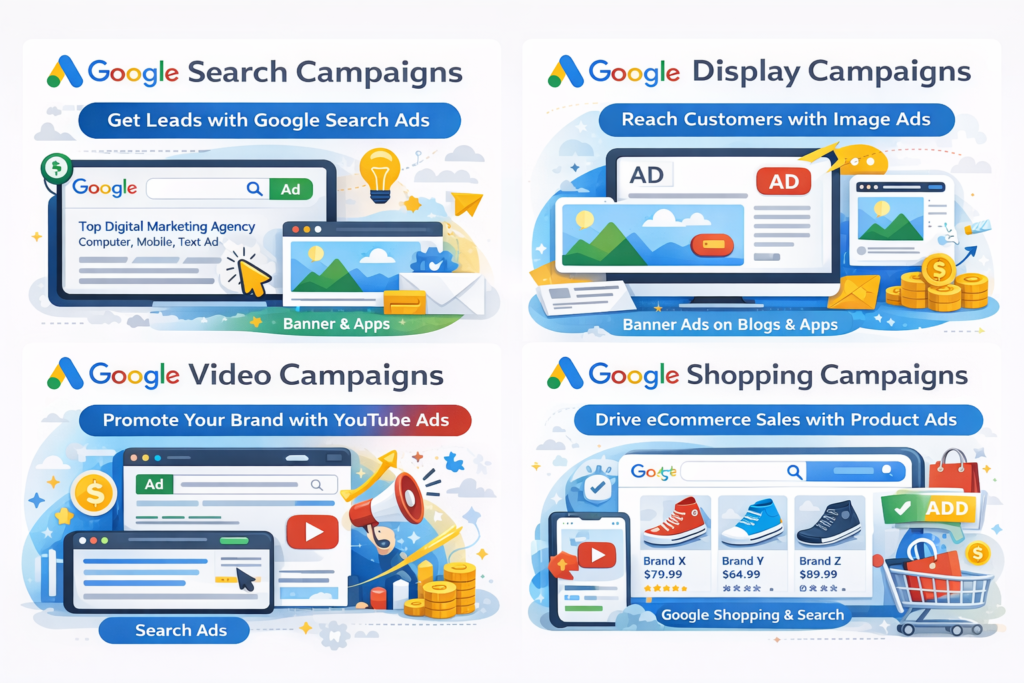
1. Search Campaigns
Search campaigns are the most popular type of campaign. These ads appear at the top of Google search results when users search for specific keywords.
How It Works
- Text-based ads
- Shown on Google Search
- Triggered by keywords
Example
User searches:
“best digital marketing agency near me”
Your ad appears at the top of the search results.
Best For
- Lead generation
- Service-based businesses
- High-intent customers
Keywords used: Google search ads, PPC search campaign
2. Display Campaigns
Display campaigns show image or banner ads across millions of websites, apps, and Gmail that are part of the Google Display Network (GDN).
How It Works
- Visual banner ads
- Shown on blogs, news sites, apps
- Focuses on brand visibility
Example
A banner ad for your brand appears while users are reading a blog or using an app.
Best For
- Brand awareness
- Remarketing
- Reaching a wide audience
3. Video Campaigns (YouTube Ads)
Video campaigns allow businesses to run ads on YouTube and video partner websites.
Types of Video Ads
- Skippable in-stream ads
- Non-skippable ads
- In-feed video ads
Example
Your ad plays before or during a YouTube video.
Best For
- Brand awareness
- Product promotion
- Storytelling marketing
4. Shopping Campaigns (Google Shopping Ads)
Shopping campaigns are mainly used by eCommerce businesses to promote products directly on Google.
How It Works
- Shows product image, price, brand
- Appears on Google Shopping & Search
- Connected with Google Merchant Center
Example
User searches:
“buy running shoes online”
Product ads with images and prices appear.
Best For
- eCommerce websites
- Online product sales
5. App Campaigns
App campaigns help promote mobile apps across Google platforms.
How It Works
- Ads appear on Search, Play Store, YouTube, Display
- Fully automated campaigns
Example
Your app ad appears on Google Play Store or YouTube.
Best For
- App installs
- App engagement
- App promotion
6. Performance Max Campaigns (PMax)
Performance Max (PMax) is an AI-powered Ads campaign that runs across all Google networks from a single campaign.
Where Ads Appear
- Search
- Display
- YouTube
- Gmail
- Discover
Example
Google automatically shows your ads where conversions are most likely.
Best For
- Maximum conversions
- Automated optimization
- Businesses with conversion tracking
7. Demand Gen Campaigns (New Generation Ads)
Demand Gen campaigns are designed to create demand and engagement using visually rich ads.
Where Ads Appear
- YouTube Shorts
- Discover feed
- Gmail
Best For
- Mid-funnel marketing
- Audience targeting
- Visual storytelling
8. Remarketing Campaigns (Retargeting Ads)
Remarketing campaigns target users who have already visited your website or interacted with your brand.
How It Works
- Shows ads to previous visitors
- Higher conversion rates
Example
User visits your website but doesn’t convert → sees your ad again later.
Best For
- Increasing conversions
- Reducing abandoned leads
- Brand recall
Which Campaign Is Best?
There is no single best campaign type. The right choice depends on goal:
- Want leads? → Search Ads
- Want brand awareness? → Display or Video Ads
- Selling products? → Shopping Ads
- Want automation? → Performance Max
- Want repeat conversions? → Remarketing Ads
Simple Explanation
- PPC = Advertising pricing model
- Google Ads = Advertising platform
Comparison Table
| Feature | PPC Advertising | Google Ads |
|---|---|---|
| Meaning | Pay-per-click pricing model | Google’s advertising platform |
| Type | Strategy / Model | Tool / Software |
| Scope | Used across many platforms | Limited to Google ecosystem |
| Examples | PPC on Google, Facebook, LinkedIn | Search Ads, Display Ads, YouTube Ads |
| Payment | Pay for each click | Mostly pay per click |
Easy Analogy
PPC is like “pay-per-use”
Google Ads is one service that uses that payment method
Importance of Google Ads in PPC Marketing
Google Ads is the most powerful PPC platform because:
- Google controls over 90% of search traffic
- Ads appear exactly when users search
- High-intent keywords drive conversions
- Advanced AI & automation improve ROI
FAQ’s
What is PPC marketing in digital marketing?
PPC (Pay Per Click) marketing is a digital advertising model where advertisers pay only when a user clicks on their ad. It is widely used across platforms such as Google Ads, Facebook Ads, LinkedIn Ads, and Microsoft Ads.
What is Google Ads?
Google Ads is an online advertising platform developed by Google that allows businesses to show paid ads on Google Search, YouTube, Google Display Network, and partner websites using the PPC advertising model.
What is the difference between Google Ads and PPC?
PPC is a pricing model where advertisers pay per click, while Google Ads is an advertising platform. Google Ads uses the PPC model, but PPC can be used on many other advertising platforms as well.
Is Google Ads the same as PPC?
No. Google Ads is not the same as PPC. Google Ads is a platform, whereas PPC is an advertising payment model used across multiple platforms.
Can PPC advertising work without Google Ads?
Yes. PPC advertising can work without Google Ads by using platforms like Facebook Ads, Instagram Ads, LinkedIn Ads, and Microsoft (Bing) Ads.
Why is Google Ads important in PPC marketing?
Google Ads is important in PPC marketing because it delivers instant visibility, high-intent traffic, advanced targeting options, budget control, and measurable ROI.